
Each Spring, Denver Public Schools (DPS) releases a document that doesn’t generate many headlines but has significant implications for students, families, and neighborhoods across Denver. It’s called the Strategic Regional Analysis (SRA).
What is the SRA?
The SRA is an annual report that provides a snapshot of DPS today and a look ahead at the district’s future. It analyzes enrollment trends, school choice patterns, academic performance, facility utilization, and demographic shifts, using current and historical data to project student enrollment across Denver’s planning regions over the next five years. The report aids district leaders in understanding where students live, where they attend school, and how those patterns are changing over time.
By examining changes at both the district and regional levels, the report helps inform decisions about resource allocation, school planning, and long-term district priorities. Alongside the district budget, it is one of DPS’ most important planning tools.
View the 2026 DPS SRA and Summary Presentation.
For Denver families, the report offers a glimpse into the decisions that will shape schools, programs, and resources in the years ahead.
We see the SRA as more than a collection of charts and forecasts. Rather, it serves as a roadmap that raises important questions about how DPS can respond to change while keeping students and families at the center of every decision.
A District Serving Fewer Students
The biggest headline from this year’s analysis is consistent with previous years: DPS K-12 enrollment continues to decline.
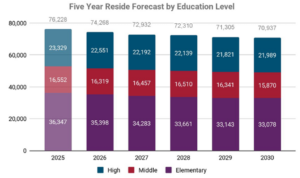
According to the latest numbers, DPS currently enrolls 76,228 resident students. DPS projects that student enrollment will decrease by approximately 7% by 2030, representing almost 5,300 fewer students across the district. Enrollment losses are expected across elementary, middle, and high schools, with the largest declines expected in elementary grades.
This trend is not unique to Denver. Lower birth rates, housing affordability challenges and broader demographic shifts are changing the number of school-aged children living in cities across the country.
For DPS, fewer students means difficult decisions ahead.
Schools are almost entirely funded based on enrollment. As student numbers decline, the district must determine how to sustain high-quality educational opportunities while operating fewer students across the same number of buildings.
District leaders have acknowledged that the regional declines, particularly in the Central region and West Side, given the combination of fewer students, small schools and low capacity utilization, will likely lead to additional school closures or consolidations in the coming years.
Communities deserve transparent data and proactive communication about the realities of declining enrollment in their neighborhoods and what that might mean for the future of their schools.
Distinct Regions, Different Realities
The SRA also reminds us that Denver is not experiencing these changes evenly.
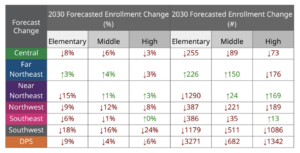
While most regions of the city are projected to lose students, the Far Northeast remains an area of growth. At the same time, the Northwest region and Southwest region continue to experience some of the most significant enrollment declines.
These trends matter because every neighborhood has different needs, histories, and hopes for its schools.
Communities that may face future consolidations deserve early, authentic engagement, not decisions delivered after the fact. Likewise, growing communities in the Far Northeast should have a meaningful role in shaping plans for new schools and future investments.
Strong public schools are built with communities, not for them.
Changing Demographics, Persistent Equity Questions
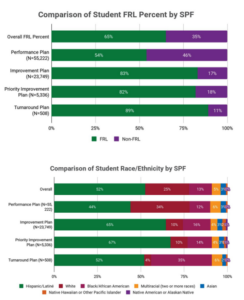
The district remains majority Latiné and continues to serve a diverse, predominantly low-income student population, with a significant number of students qualifying for Free or Reduced Price Lunch (FRL). However, these demographics are gradually shifting, as the share of Latiné students has declined from 56% to 52% and FRL participation has fallen from 69% to 65%. The share of White and non-FRL students has increased modestly.
Demographic change raises important questions about who Denver’s public schools serve, which families can remain in the city, and whether access to high-quality educational opportunities is becoming more equitable over time.
Families have consistently told us that equity is not just about access; it’s about outcomes. Addressing persistent opportunity and achievement gaps remains one of the district’s most important challenges.
The Growing Challenge of Underutilized Schools
The 2026 SRA projects that declining enrollment will continue to reduce utilization of DPS facilities, with the average school building expected to operate at 74% of its capacity by 2030. As more schools become underutilized, the district will face decisions about school consolidations, closures, and the future use of vacant or partially occupied facilities.
As DPS considers additional school closures, decisions about facility use should remain focused on students.
During a recent debate, a six-member board majority signaled that commitment, with DPS Board of Education Vice President Monica Hunter stating, “I do believe that all children are our children, and every child deserves access to a high-quality building…They are asking for a quality place to send their kids for learning, and I do believe that all kids deserve access to that, and that’s what this building does.”
At the same time, the school board is debating an Executive Limitation on Facility Usage, Policy EL.20 – Facilities Usage, which could shift greater authority over facility utilization decisions to the board. How DPS balances enrollment realities, community priorities, and governance questions will play a significant role in shaping the district’s long-term facilities strategy.
Academic Opportunity Is Shaped By Where Students Live
The SRA also examines academic performance by comparing state School Performance Framework (SPF) ratings with district subregions and student demographic data. The analysis shows substantial variation in the distribution of higher-performing schools across Denver.
In the Southeast region, 87% of schools are rated Green/Performance Plan, compared with 40% in the Far Northeast and 57% in the Southwest regions.
The report also identifies disparities by race and income. White and non-FRL students are overrepresented in Green/Performance Plan schools relative to their share of district enrollment. Students of color and FRL-eligible students are overrepresented in the district’s lowest-performing schools.
These findings illustrate differences in access to higher-performing schools across regions and student groups within the district. For families, where they live should not determine the quality of educational opportunities available to them, which is why these disparities deserve continued attention from district leaders and the community.
SchoolChoice Remains a Defining Feature of DPS
Today, nearly half of DPS students attend a school outside their assigned boundaries or enrollment zones. That reality reflects DPS’ commitment to choice for its families and the uneven distribution of educational opportunities across the district.
The SRA highlights differences in school choice participation across student groups. Low-income families are more likely than higher-income families to enroll outside their assigned boundaries (45% vs. 39%), and Black and Latiné students do so at higher rates than White students. These patterns suggest that school choice remains a key pathway for many families seeking options beyond their neighborhood schools.
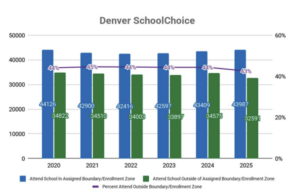
Families value having options, and many use the choice process to find programs that best meet their needs. At the same time, high levels of choice can signal that some families do not feel their boundary school is the best fit.
As DPS begins conversations this summer and fall about enrollment zones and school boundaries, as required under the board’s EL.19 policy, family choice will remain a key part of the discussion.
The SRA highlights enrollment zones as an effective strategy for expanding access to schools, with high match rates for transitioning grades (95% for kindergarten and 84% for sixth grade) showing strong alignment between family preferences and available seats, while also supporting greater diversity and access through broader school and transportation options.
Charter schools also play an important role. They serve diverse student populations, enroll students throughout the year, and attract families from outside Denver, with schools such as Rocky Mountain Prep (RMP) Creekside, Highline Southeast, Denver School of Science and Technology (DSST) Montview, and DSST Conservatory Green each enrolling more than 100 out-of-district students and bringing additional enrollment, and funding into DPS.
Data transparency helps turn questions into action. The 2026 SRA sheds light on how access to high-performing schools varies across Denver, underscoring the importance of making data accessible for families.
Need help finding transparent data about DPS schools? The Mile High School Guide was created with direct input from families and educators across Denver. It highlights academic and non-academic factors families say matter most, like school culture, demographics, and student experience.
What Comes Next
One of the most important takeaways from the 2026 SRA is that DPS is entering a period of significant transition.
Enrollment is declining. Building utilization is decreasing. Demographics are shifting. Some communities are growing while others are shrinking. At the same time, families continue to seek high-quality schools and diverse educational options.
The decisions made over the next several years will shape the future of public education in Denver for a generation. As those conversations continue, data should inform decisions, but community voice should shape them.
Families, students, educators, and community leaders all bring valuable perspectives on what thriving schools look like. The strongest solutions will emerge when those voices are incorporated into district planning from the beginning.
We will continue to analyze the SRA and share additional insights in the weeks ahead. Stay connected through our blog and social channels as we work to keep families informed and engaged in the future of Denver public education.